
Spur vs. Helical Gears: Choosing the Right Solution for Your Application

Not all gears are created equal. Understanding the fundamental differences can save you time, money, and machine downtime.
[BODY PARAGRAPH — use "Paragraph" style]
When it comes to power transmission, gear selection is one of the most consequential engineering decisions you'll make. Choose wrong, and you're looking at premature wear, excessive noise, or outright mechanical failure. Choose right, and your system runs quietly and efficiently for years.
At Helix Precision, we work with engineers and designers across dozens of industries — and the question we hear most often is deceptively simple: spur gears or helical gears? Here's the breakdown.
The Fundamentals
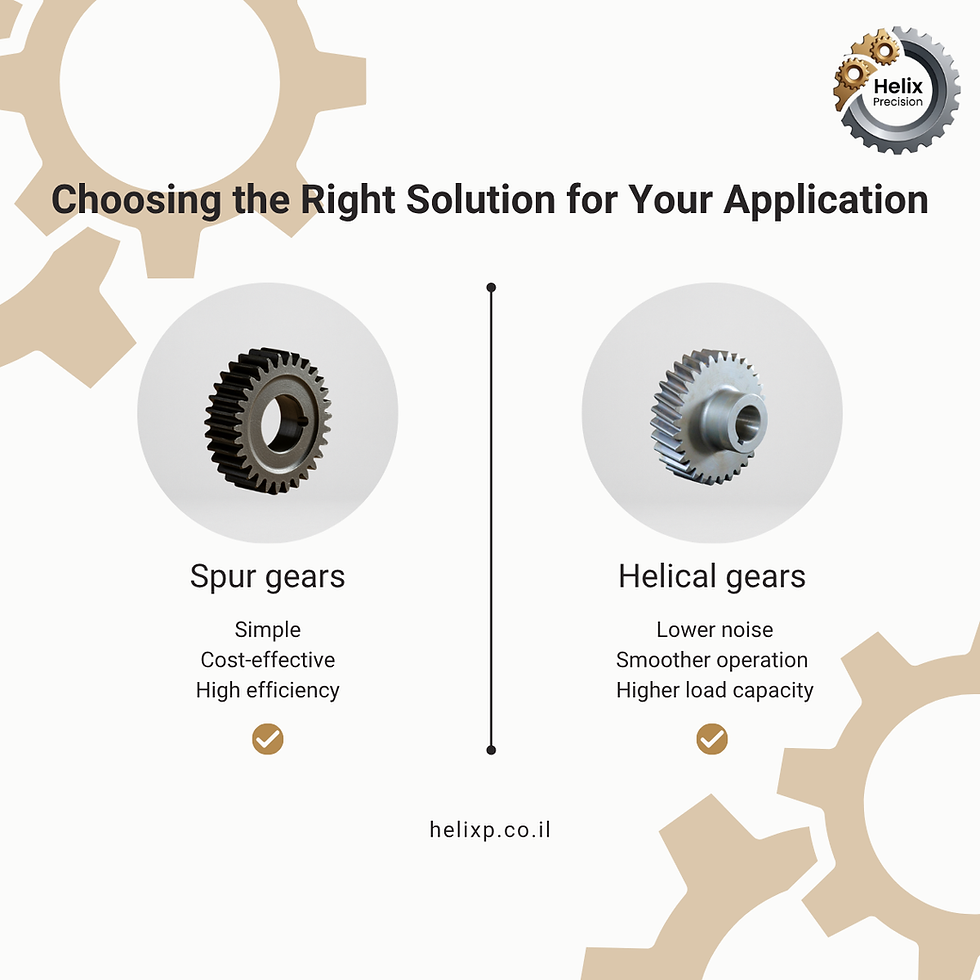
Both gear types transmit rotational motion and torque between parallel shafts, but the way they do it is fundamentally different. Spur gears have straight teeth cut parallel to the gear axis. Helical gears have teeth cut at an angle — the helix angle — which changes how force is transferred during meshing.
Spur Gears: Simple, Efficient, Cost-Effective
Spur gears are the workhorses of the gear world. Their straight-tooth geometry makes them efficient and straightforward to manufacture — no complex helix angle to calculate, no axial thrust forces to compensate for.
Key advantages:
• Simple design and easy manufacturing
• Cost-effective for most budgets
• High efficiency with minimal energy loss
• Easy to align and maintain
• Ideal for low-to-moderate speed applications
Think conveyor systems, washing machine drums, or speed-reduction stages in a gearbox. Wherever noise isn't a critical concern and loads are predictable, spur gears deliver reliable performance at a lower price point.
Helical Gears: Smoother, Quieter, Higher Capacity
As speeds increase and noise constraints tighten, helical gears come into their own. Because multiple teeth are in contact at any given moment, load is distributed more evenly across the gear face — reducing peak stress on individual teeth, extending gear life, and dramatically reducing operating noise.
Key advantages:
• Lower operating noise
• Smoother, gradual tooth engagement
• Higher load capacity per unit width
• Ideal for high-speed applications
• Better suited to heavy-duty use
The tradeoff? Helical gears generate axial thrust loads that your bearings must accommodate, and the angled tooth geometry adds complexity to both manufacturing and installation. For demanding applications — automotive transmissions, industrial pumps, precision machinery — the performance gains are well worth it.
"The best gear isn't always the most sophisticated — it's the one that matches your application's demands precisely."
Making the Right Choice
There's no universal answer — the right gear depends on your speed range, load profile, noise tolerance, budget, and design constraints. Start with your operating conditions and work backwards: define your torque, RPM range, duty cycle, and allowable noise levels before selecting a gear type.
At Helix Precision, our engineering team is available to help you model your application and select the optimal gear solution — whether that's a standard spur gear off the shelf or a custom helical set machined to your exact specifications.


Comments